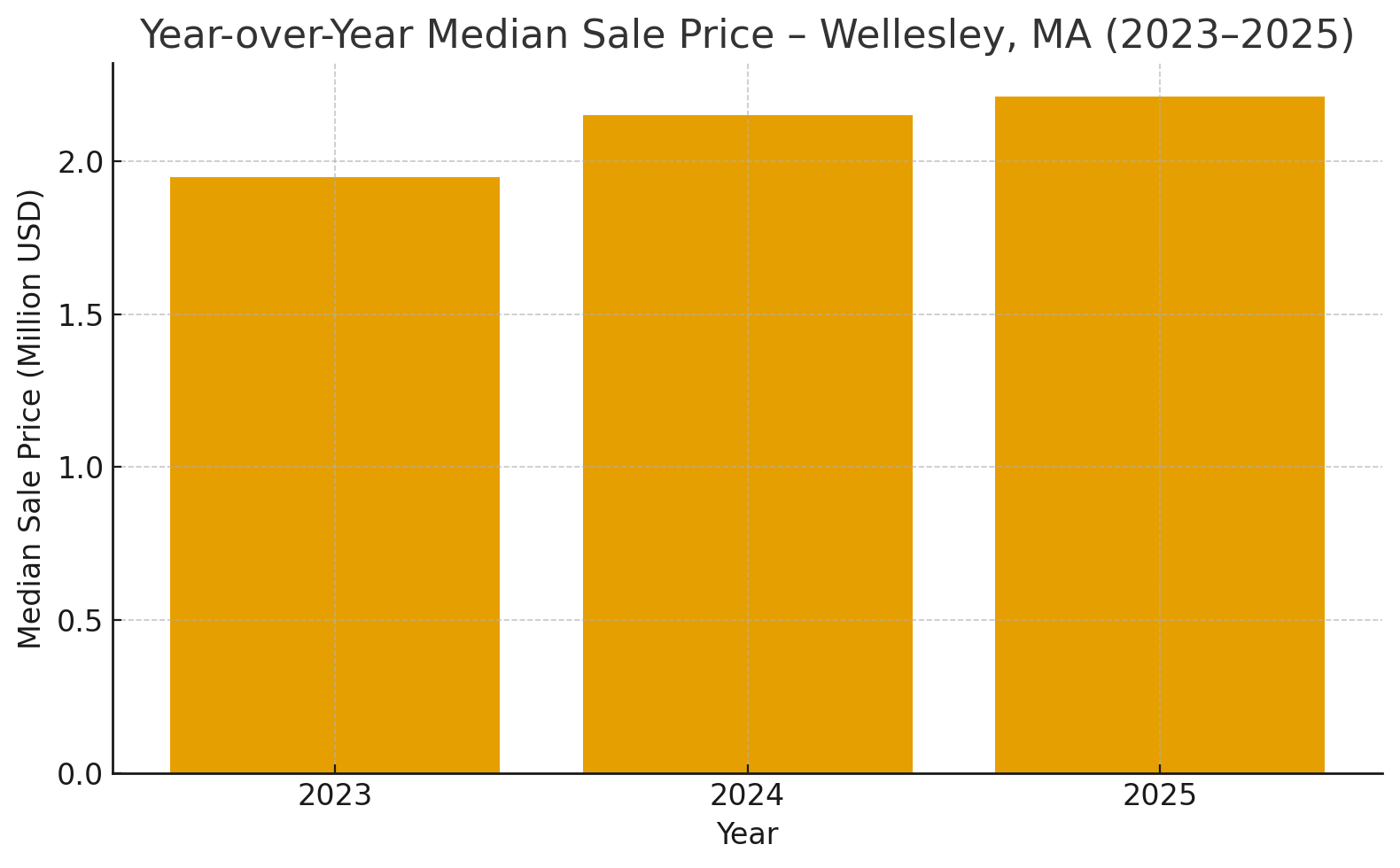
If you thought the days of bidding wars were over, Wellesley has other ideas.
Between 2023 and 2025, nearly half of all single-family homes sold above their asking price — a statistic that would sound implausible in most markets, but in this zip code, it’s practically muscle memory.
The Numbers Behind the Frenzy
Out of 672 sales since 2023:
322 homes (48%) sold above list price.
291 homes (43%) sold below list.
The average sale-to-list ratio across all deals: 101.7%.
That means, on average, sellers walked away with roughly 1.7% more than their asking price — a quiet but powerful testament to just how deep demand runs in Wellesley’s luxury segment.
At the extremes, one sale fetched 148% of its list price, while the biggest miss closed at just 82% — outliers that illustrate how pricing strategy, not just property, can make or break a deal.
The Yearly Pulse
The data paints a steady narrative:
YearAvg Sale-to-List Ratio% of Homes Sold Over Ask2023102.2%48.9%2024102.0%50.6%2025100.5%43.2%
Even as mortgage rates climbed and headlines declared a housing cooldown, the Wellesley market barely blinked.
The takeaway? Buyers didn’t vanish — they just became more tactical, pouncing when the right property hit the market.
Psychology of the Over-Ask
If markets are about fear and greed, Wellesley operates on a third emotion: FOMO — the fear of missing out on that one perfect house on Cliff Road.
With limited inventory and a consistent pool of buyers (many relocating from Boston or Cambridge), even modest listings can trigger multi-offer showdowns.
A $2.5 million listing that sells for $2.6M isn’t speculative froth — it’s the new equilibrium.
Why It Matters for Sellers
For homeowners, the lesson is simple but nuanced: pricing right still wins.
Overpricing leads to stagnation; underpricing invites a feeding frenzy that often delivers above-market results. The sweet spot is a realistic list price paired with impeccable presentation — think staged, photographed, and timed to hit the spring wave.
The Bigger Picture
Zooming out, the consistency of Wellesley’s over-ask trend tells us something broader about suburban economics post-2020: premium suburbs remain insulated from volatility.
While other regions saw pandemic spikes followed by retractions, Wellesley’s line barely wavered — a suburban blue chip quietly compounding in value.
Final Thought
Even in a higher-rate world, emotion still moves markets. And in Wellesley, emotion is spelled with a dollar sign — and usually, it’s a little higher than the one on the listing sheet.